This post is part 3 of a 3 part rant of dumb shit I’ve heard from running haters who have no idea what they’re talking about, but think they do. Today’s myth:
You can run faster by weight lifting.

The theory
 |
| You know this is bullshit, right? |
Running uses a complex combination of hamstrings, glutes, calves, core, arm, chest, and back muscles. By strengthening those muscles, you will be able to put out more power and therefore move farther with every step, and therefore run faster. Or maybe the idea is that by strengthening your glutes/hamstrings/core that will erase any dysfunctional movement patters you have like quad dominance, lower cross syndrome, gluteal amnesia, or a lack of core engagement.
...or something. It’s one of those things that’s so intuitive, that I bet a lot of people never really sit down and think it through. If you did think it through, you might come up with the following arguments:
But wait! The fast twitch muscle fibers…

Everybody knows that fast twitch muscle fibers are for running fast, and slow twitch fibers are for endurance running; and that some fast twitch fibers can be trained to behave like slow twitch fibers. Anaerobic activities such as weightlifting use fast twitch fibers, and preserve swinger fibers as fast-twitch-ish.
If you want to run faster, then you will need more fast twitch fibers, right?

Not so much. First of all, your fast twitch fibers become less and less relevant in events lasting more than 30s to a minute. Beyond that, your fast twitch fibers are too slow to recover to contribute in a meaningful way to distances from 5K to the marathon, unless of course you’re the rare individual who can run a marathon if 57 seconds... In fact, if your “swinger” fibers are all more fast twitch oriented, then they could actually be counterproductive in events of 10 miles or longer where fatigue resistance and glycogen sparing are factors that have a huge impact on finishing times (fast twitch fibers are not only faster to fatigue and slower to recover, but also consume much more glycogen - energy - than slow-twitch fibers, making you more likely to bonk if you've got too many of them. More on this later). Honestly, if you’re endurance training, the effects of weight training aren’t going to outweigh the stimulus of your cardio training on the orientation of your muscle fibers that much anyway.
There is something to be said for training your neuromuscular pathways to engage more quickly and accurately, and some coaches have used this as a reason for using Olympic lifting in athletes’ programs (the snatch includes the fastest human movement ever measured). However, these skills are less crucial at the longer distances and can be more safely, efficiently, and contextually applied using plyometric and balance work as I will discuss in the next section.
Runners gonna run, son

If you want to get better at golf, you shouldn’t train by chopping wood. The principle of specificity states that the method of training that will have the most positive impact on any sport will be the exercise that best simulates the movements of that sport. Thus, if you want to squat more weight, actually squatting will have more of an impact on your squat than a leg press, which will still have more of an impact than a leg extension machine. And if you want to add more power to your run, then run. Hills, sprints, hill sprints, and resisted runs (think: dragging a tire or a parachute behind you) will all have more of a positive impact on your running power and strength than lunges and deadlifts.
 |
| It is better to have many muscle fibers that work together than just a few really huge fibers blowing a gasket to get the job done |
Also, running is a series of many, many sub-maximal muscle contractions. So it does very little good to build power by building gigantic muscle fibers that will be just as quick to fatigue (or quicker if they have turned the corner back to fast-twitch-behaving). Instead, the goal should be to teach your body to engage more of your available muscle fibers at once. Just like the old saying that we only use 10% of our brains, we only use a fraction of our available muscle fibers. As a runner becomes more efficient, it takes even fewer muscle fibers to do the same amount of work. Let’s call these “favorite fibers” the A, B, and C fibers. If you don’t change up the pace enough and do enough hard running, your brain begins to “forget” its pathways to the less frequently used fibers (the D, E, F… L, M, N, O, P fibers), and it becomes much harder to recruit the number of fibers that you need for faster running when you need them. Your are also screwed when your "favorite" fibers finally give out from fatigue. I see this a lot with Ironman athletes, who have one speed that they can run for hours, but crumple if they try to push the pace by even 15s per mile for a few minutes.
 |
| Like a rowing crew, your muscle fibers are more powerful when they are synchronized. |
The best way to improve your neuromuscular recruitment of your D, E, F fibers, is to do exercises that mimic the running motion but in an explosive way that require a greater power output in the same amount of time. That means exercises like sprinting, hill running, bounding, and plyometrics. These exercises not only teach you to engage your A through Z fibers at the same time, but also teaches them to coordinate so that they can fire in one big clap of fire, rather than fizzling by firing fractions of a second apart (because the rusty fibers take longer to come to the party).
Resistance training as Prehab/Rehab
| WTF? Why would a runner do push-ups. |
A lot of runners, and running coaches, and running authors think that if muscles are imbalanced or underactive, all one has to do is strengthen the underactive musce (or the antagonist muscle to the overactive muscle), and voilá you will be fixed. Unfortunately, that rarely works because the problem is very rarely in the muscle; it’s in the brain.
Let’s say that you have a knee problem caused by underactive glute medius and minimus (hereafter referred to as “side butt”) muscles. The running books suggest that you lie on your side and do some Jane Fonda leg raises to strengthen your hip abductor muscles. For most of us, you will automatically default to using whatever “wrong” muscle to do the exercise that you have been using to compensate for your sidebutt while running (probably your hip flexors). If you’re not a completely hopeless case, you may actually be able to feel this in the correct muscles, however, the movement center in your brain has received absolutely no cues to tell it that this muscle should be used in the running stride. Instead, you’re just learning to be really good at leg raises (remember that whole specificity thing?). So you will go back to running after a day of sweatin’ to the oldies, and you will drop right back into the dysfunctional stride that you have spent millions of steps practicing. And your knee will keep hurting.
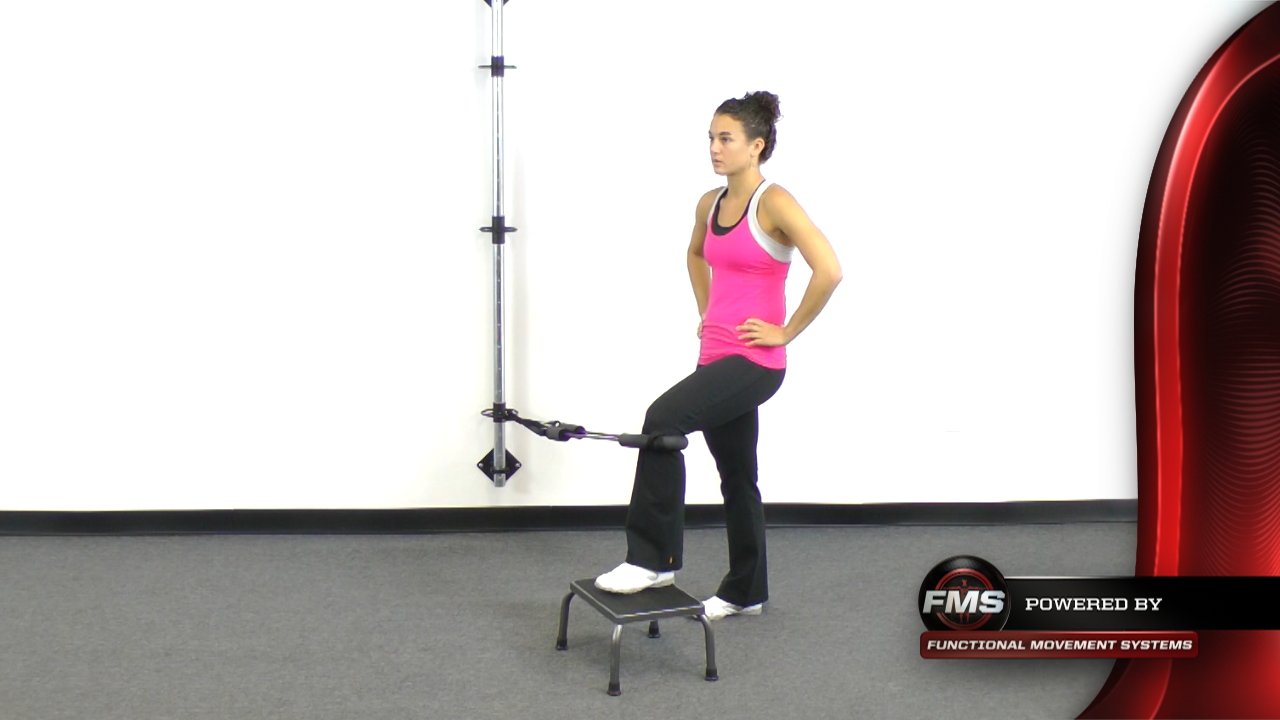
Instead, just like you did when you were trying to improve overall strength with running, you need to find a way to accentuate the resistance on that specific muscle in the context of a running motion. It may take a few repetitions of isolating the muscle you are targeting with clam shells to get you to be able to feel that muscle at all (called “activation”), but once you know where it is, then it’s time to get back to stepping motions. In the example of the sidebutt, this can be accomplished by doing stepping motions (lunges, step-ups, surrenders) with a band around your stepping knee, pulling it toward the inside. That way your sidebutt learns to engage to stabilize your knee while the bigger hamstring, glute, and calf muscles are doing the hard work of extending your hip and knee in order to move you forward.

Similarly, many runners lack core stability when they are running. Not really understanding what “core stability” is -- or even what the “core” is -- they do a lot of crunches and assume that that’s doing something to change their running. The “core stability” that most runners lack is actually pelvic stability, and the rectus abs (the muscles isolated in a crunch) are only a small part of pelvic stabilization, especially when you practice using them to pull down on the ribs rather than up on the pelvis. Instead, you have to train a combination of muscles including the glutes, transverse abs, obliques, hip flexors, hip abductors and adductors, and yes, the rectus abs to contract and relax in the right combination in order to keep your pelvis from tilting forward or side-to-side as you run and thus throwing off the entire concert of muscle contraction from your toes to your neck. How do we do that? You guessed it: by learning to stabilize the pelvis (correctly!) first in static exercises like the plank, and then in increasingly more dynamic and unstable exercises that more and more closely mimic the movements of running.
Toughen up!
 |
| I don't see what drooling on your sports bra has to do with HIIT training. And what is that in her hand? A purse? You can't do anything intense with a 5lb kettlebell. |
I have heard the argument put forth (mostly by the Crossfit Endurance camp - followed by no successful elite endurance athlete ever) that high intensity circuit training can improve endurance performance by increasing your tolerance for high-intensity activity. This is like training for t'ai chi by boxing. Theoretically the mechanism behind this is improved lactate clearing or something. However, you will never be producing lactate at such a prodigious rate when racing the 5K or longer as you do in a high-intensity interval weight training workout. Because of the high intensity of a circuit workout, you will also need to give those working muscles a rest at some point while you keep your heart rate high by training another muscle group. This means that A) your muscles still do the bulk of their lactate clearing while at rest, and B) you are wasting time training non-running-specific muscles; time that could otherwise be spent improving your running. And there’s another problem with weightlifting as a form of cardio training…
Bulky muscles are bad for endurance
There is a time for re-building muscle mass, but it is in the offseason not in your race build-up. Too much muscle excess muscle during the competitive season harms your endurance performance in 3 ways:
 It increases the amount of mass that you need to carry. Jack Daniels estimates that for every pound of body mass you gain, you run 2s slower at the same effort. Even though muscle is active mass, that doesn’t mean that it’s actively helping you run. Runners don’t need really big pecs or biceps. The idea should be to be more efficient with many smaller fibers than to build big, burly ones. Because....
 Increasing your muscle mass increases the metabolic cost of running. In longer events, performance is limited to a large degree by your body’s ability to spare its stored glycogen. More muscle mass does increase the amount of glycogen you can store by a little bit, but it also increases the rate at which you will burn it, especially if you have lots of muscle tissue in your upper body that will just drain your liver of glycogen meant for your legs. And if you have a fussy running tummy (or bowel), remember that the faster you burn energy, the more you will have to eat more in a race to replace it. And the faster you're going in a race, the more it will affect your digestion, and the more likely your race nutrition will be to turn to runner's trots than useable energy. If you can’t pack in the food fast enough, you will hit the wall sooner. And with that metabolic cost also comes…
 Heat! All muscle contractions throw off heat as a byproduct. How fast your body will allow you to run in a race is in part determined by your core body temperature. The more active lean mass you have, the more heat that muscle will create. And the larger you are, the less surface area you will have in proportion to your mass to dissipate that heat, and increasing the likelihood of overheating. All this will produce a slight but not insignificant increase in body heat that will convince your brain to do something drastic to put a cap on your performance. In my case, it makes me feel like I’m going to crap my pants, but you may be a puker, a wheezer, a fainter, a heavy leg-er, or an unbearable muscle burner. All are just ways for your unconscious brain to slow you down from the biological threat of overheating.
How resistance training helps
I’m not saying that a well designed resistance training routine has no place in a running program. However, your average meathead trainer isn’t following these factors for success:
- Offseason muscle building. Since running is a catabolic (muscle-wasting) activity, you do need to take part of the year to build some muscle back on so you don’t waste away until you look like a 90’s perfume ad. http://famousmisfortune.com/wp-content/uploads/2014/02/katemoss.jpg
- Prehab and rehab work can and should be done year round, but should be done in a context that mimics the movement of running as closely as possible and will most likely include balance work and bands more than weights and machines.
- To improve your running power, you are better off doing so by actually running, with a little bit of plyometric work thrown in if you are injury free.
And with that I conclude my, “Shut up your face because you don’t know what the fuck you’re talking about!” series.


No comments:
Post a Comment