Tuesday, May 21, 2013

Day 6: Mark Allen Still Haunts My Daydreams


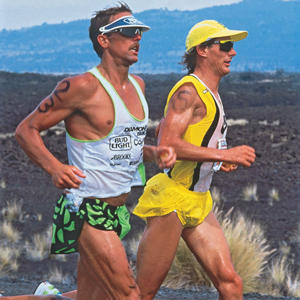
Many, many years ago I wrote a post about how Mark Allen haunts my dreams. Well, as I ran the day's 30K, I began listening to Matt Fitzgerald's "Iron War." I've seen the entire footage from that 1989 Ironman, heard interviews with both Mark Allen and Dave Scott about the race countless times, and I think the story's been told to death, but I love Matt Fitzgerald and will faithfully read everything he will ever write. So there I was, listening to the tale of the Iron War for the bajillionth time as I ran the last 8.6 miles of the day's 18.6 miles.

I had already run 7 miles on the treadmill that morning, and done a lazy 9 miles on the bike to make up for 3 miles that I thought it would be unwise to run before I hit the Los Troncos trail. I ran the trail not feeling particularly strong, but also not feeling weak either. I just didn't feel like I had the turbo boosters on today. But I had still comfortably averaged 7mph in my earlier run, something that had been a challenge even a couple of weeks ago. And I finished the 8.5 mile hilly Los Troncos trail in only 4 minutes slower than my best time for the trail.

As I got in the car, I was still listening to Matt Fitzgerald talk about Mark Allen and how he used what I have disparagingly called the "zone 1" method of training in the past. In essence "Zone 1" training is where you determine a heart rate below threshold, and spend nearly all of your training time there. The idea is that you wind up getting really fast while not going very hard, but it always seemed like a load of bullshit for lazy people to me. But then Mark Allen crashed my daydreams again, and I realized that, isn't that exactly what I'm doing right now? I'm running only as fast as is comfortable so as not to poop myself out too much. When an effort requires me to dig or push in order to keep running, I just walk. And against all odds, I appear to be getting faster.

More evidence is needed, of course. But if I wind up a faster runner at the end of this gluttony of overtraining, then I think that we will all have to eat our hats in one way or another; me because the Zone 1 method of training seems to have something to it, and you because you thought that I would just get fat and slow and injured. For my own sake, I hope we're both wrong.

Day 4: If I can get through today...

...I can do anything. 

-5h sleep
-9 sessions between 5am and 3pm
-Less than 30 min seated all day
-65.8 miles in my legs since Sunday, BEFORE I started the day's running
-Approximately 1600 calories consumed from start of workday to finish of workout (13h)

My 30k looked like this:
-1 mi walking between clients (so I wouldn't need a shower)
-3.5 miles descending speed (finishing at 8:00 pace) when a client canceled
-2.4 mi at lunch, descending speed to 8 min/mi
-Ride 23 mi on spin bike (7 2/3 mi run equivalent) after last client until kicked out by spin class
-4.03 mi run descending to 7:56 pace. 

And I did it. I am invincible. I need a nap. And a burger. And a cupcake.

Day 3: Rules of the game

So I've decided to run 30K a day for 30 days. I mentioned that. Why am I doing this? You can see a previous post about marathon monks to learn about where I got the inspiration from, but I'm not trying to emulate those monks. I'm just curious about what will happen. Can my body handle it? And if my body can handle it, then what will happen at the end? Conventional wisdom says that I will get slower, but I want to see if it's true. Today, anyway, on my 30th birthday – and the third consecutive day of running 30K – I was running faster in the last 5 miles of my day's run than I did at any point in my 7 consecutive half marathons a few months ago. In fact, that little stunt seems to have launched my running to a new level... but I digress.

Here are my rules for the challenge:

  1. Once begun, I must run 30K a day (or equivalent, see below) on every day that I work. Weekends and vacations (5 days in Arkansas for a wedding), I will not run.
  2. The 30K can be broken however needed to fit into my work schedule. They may be run on treadmill, trail, or road.
  3. In the event of small injuries, I may 

Day 5: Dehydration


The biggest challenge so far has been sweat. Sweat leads to chafe indoors (not to mention annoyed looks from maintenance staff and concerned looks from everyone else), and severe fluid losses outdoors. I tried getting a hydration pack, but look back on Day 2 to see what happened with that.

Day 5 was a hot one: about 87 degrees of dry heat, meaning the first really hot day that I would have to take on in my 30 in 30 challenge. I planned to run 4 miles indoors, and then hit a 7.4-mile loop on a place called Windy Hill, which I would run twice. But since I've been living in San Francisco, where the summers look like early April wherever you live (highs in the 50's and overcast), this is the first time my body has had to deal with heat in 3 years. In the past, heat has not worked out well for me.

Windy Hill climbs and descends some 1200 feet, with a flat and exciting mile along the ridge at the summit (I have a video from the top, and maybe I won't be too lazy to upload it later). My first climb was a slow walk-jog on the sunny side of the trail, and then a tender-footed descent through the trees on the back side. Realizing that I was way, way behind schedule with 7 miles to go, I decided to cut out one mile and walk the last mile at home with my lovely girlfriend and the dog. That would make it easier, right? Well, not really. I would get to cut out the exciting and fun flat at the top of the ridge, but still have to climb the hill in its entirety in my final 6 miles. I ran 3 miles straight up, and then turned around and ran back down the way I'd come.

When I got back to the car, I'd been running for 2.5 hours on 32 oz of water in heat in the mid-80's. I was covered in salt and my muscles ached all over. For the first time I doubted the viability of this adventure. After drinking over 3 liters of water before bed, I still woke up with a raging dehydration headache. I put away another 3 liters of water in the morning before starting on the day's 30K.

Wednesday, May 15, 2013

Day 2: Review for Nathan Women's Intensity Hydration Pack


Today I tried running 10 of my 30K with my new Nathan Women's Intensity Hydration Pack. I liked the sexy blue, and that I could carry more water onboard than just a 16oz handheld bottle.

Here is my review:

Tuesday, May 14, 2013

Day 1: Mayday! Mayday!

For my 30th birthday I've decided to run 30K a day, every day that I work, until I've done it 30 times. Since I'm only doing it on work days, the 30 days are not consecutive. Why? I'll save that for another post. I've got a better story.

Today was Day 1 of my 30 in 30. Today I also happen to be on my period. It's gross, but it's a fact of life, and it's relevant to the story. When it's "that time of the month" a girl has a decision to make: stick a diaper in your underwear or jam a wad of cotton up your twat. Both are unpleasant and offer all disadvantages and no advantages. I went for the crappy "disadvantage" that they have free at work with no wings and cheap adhesive. Then I went out to the treadmill to zone out and watch some TV.


18.6 miles on a treadmill might sound like torture to you, but I don't mind it, especially if I have limited time. Treadmills do make me sweat more though. I sweat a lot. By mile 16 I was soaked in sweat, my shorts were plastered to my legs, and the maintenance lady on her hands and knees cleaning in front of my treadmill was looking really pissed at the sweaty mess I was making. But I was still feeling really good, able to push the pace from time to time to keep it interesting when... All of a sudden... Oh fuck!

Is that?

Yeah, I'm pretty sure... What do I do if...?!

It felt like my "disadvantage" had shifted. If it had just drifted backward in my underpants, that wouldn't be so bad, so I dropped to a walk and tried to discretely investigate. In case you're wondering, No, there is no way to discretely check that something in your underwear is still in your underwear. Something was definitely wrong. Or had I started my run with a pad at mid-thigh?

This was bad. There are 2 bathrooms in the building: each about 100m away in either direction. Behind me was another row of cardio equipment. All I could picture was my bloody "inconvenience" falling out of my shorts, hitting the treadmill, being launched across the room, and flying into the shins of the 2:20 marathoner running directly behind me (how often do you get to say that?!). MAYDAY! MAYDAY! SOMEBODY HELP ME! 

I stopped the treadmill and waddled to the bathroom, pressing my thighs together the whole time and all the while ready to react faster than the speed of light if my "problem" plopped on the floor along the way. Somehow I made it to the stall, pulled the world's grossest pad out of the bottom hem of my shorts, and cleaned myself up. 

But I still had 1.8 miles left to run... 

Use your imagination. 

Friday, April 19, 2013

Boston

This post is late. Like everyone else, I have been glued to the television and social media to make sure that my friends and loved ones are okay. Monday was a frantic day, loading and reloading social media because I didn't even know who to check up on. Anyone could have been there. Many people that I know were there but everyone is okay. Thank god. I did run cross country in high school with one of the cops that was shot, but I barely knew him.

When a client first mentioned something about an "explosion at the marathon finish line," I thought it was an MIT prank gone awry. An explosion at the Boston Marathon finish line? What? That makes no sense. No one would notice a dancing bear at the Boston Marathon finish line. I've been there. It's pandemonium. Then I walked by a TV screen and saw what he meant: runners crossing the finish line, and then an explosion, a man that looked like Grandpa hitting the ground, and other runners turning around as they ran the final few yards and hit their watches, because who's thinking about danger at a marathon finish line? All I could think about was how many times I'd had the thought at a marathon finish line at that moment I couldn't get out of the way of a speeding train. The stories of the runners who jumped to help the injured, or kept running to the hospital to donate blood hit me and every marathoner right in the heart. And what about the people 5 blocks back who just wanted to finish and now had to walk farther in the other direction with no food or water just to get home? Of course these people weren't the victims, but it's human nature to ask, who would I be in this tragedy?

Once the crowds were cleared, the victims' families had been reached, and the immediate shock of the incident had passed, the rest could sink in. I heard criticism of runners standing up self-righteously on the news and saying, "This will not keep me from running!" This is not about you, you self-important ass. Yes, there is a tendency for everyone to make tragedy about them, but it's true, this attack was not an attack on running. The Boston Marathon just happened to be an obvious target for some sickos to get some attention by hurting and killing some innocent people. But all the same, for the fitness community, it hit close to home.

As athletes and runners, we know that running stands for good. Runners and endurance athletes are not all saints, but when we are running, often that is the most positive thing in our lives. Running is the only way we know how to solve life's unsolvable problems and become better people. Whether becoming a better person means raising money for cancer research, or just blowing off steam so that we don't strangle our boss, when we are running we are innocent; as benign and separate from international politics as a classroom full of kindergarteners.

The finish line of a marathon symbolizes more than innocence. The finish line symbolizes achievement, and the culmination of months and years of runs that have brought us to that finish line better people. The finish line symbolizes overcoming fatigue, pain, and adversity to reach a goal that is important enough for you to endure that discomfort. The marathon finish line is an allegory for overcoming the adversity in life as well. If you can finish a marathon, then you can get through this tough patch at work, or survive a new baby, or survive the grief of a break-up, and come out stronger in the end. The Boston Marathon especially is the subject of every distance runner's fantasies. While most marathons are the culmination of months of work, the Boston Marathon is often the culmination of years of hard and dedicated work, a lifetime achievement that no one can take away from you. Something that will give you confidence forever.

The finish line of a marathon is also when you get to share your lonely sport and its quiet accomplishments with the people you love. If you have never run the Boston Marathon, then you should. There are people cheering for you every step of the way, and the entire city shuts down to come cheer in the runners. It is the only event I know where the Red Sox game that happens every Marathon Monday Morning is the opening band to the Big Event. This is the chance for family, friends, and loved ones to take part in your accomplishment. And in Boston this year, it wasn't the runners who were killed, but the spectators: the people who took their day off to celebrate our accomplishments.

And now runners around the country have been shaken to the bones. And as runners, we don't know how to fix the evil of the world except to run. So I will continue to run. Not because Boston was an attack on runners, but because running is a sport that I love, and I want to make it possible for myself and other runners to make the world a better place by placing finish lines on every road that we tread.