 I've been doing some thinking lately about training and what makes some people successful, while others seem to just be running in place (no pun intended). This will probably be a long, rambling post. Feel free to read all or part of it, or none at all. Just a short disclaimer: These are just some thoughts that have been kicking around in my head. I am not trying to portray myself as a coach, nor do I think anyone should actually take me up on some of the things I say unless they are on the same page to begin with. I am not a doctor, or a physiotherapist, or a sports psychologist, nor have I so much as taken a biology class since high school. I used to have a personal training certification, but I even let that expire when I realized that I wasn't a people person (can you tell?). Everything I say in this post is just an opinion based on my own experience and things that I have read/heard or figured out for myself. I am writing this post more to myself than offering advice to anyone else. I'm just posting it because someone out there might be dorky enough to find it interesting. Disagree with me all you want. I encourage you to challenge me. You don't have to care what I think, but since you're here, I'm going to assume that you do.
Introduction
 In the past year, Brett Sutton has been getting a lot of attention for his success his athletes such as Chrissie Wellington, Bella Comerford, Erika Csomor (I LOVE her blog, she's such a space case!), Hillary Biscay, Rebecca Preston... the list goes on. Critics say that he wears his athletes into the ground and doesn't have the long-term in mind. But before Brett Sutton, Simon Lessing was unbeatable for the better part of the '90s because of his balls-out-every-day style of training. Lance Armstrong insists he was so dominant because he was just willing to train harder and more often than anyone else, even in the offseason. I've heard stories of TBB (Brett Sutton's team) athletes having to run marathons on treadmills in barren hallways with no music or air conditioning, run 20 miles worth of 800m repeats, do 10 ironmans in a season, etc. And meanwhile all the tri-geeks in the world will tell you that that kind of training is unnecessary. That you don't have to train like that to be successful. That you need to REST. Training like that will make your legs explode and your arms fall off and your soul get cavities. All I wonder is why so many people are so afraid to train?
I've talked a bit about this before. I think that the people who are successful in this sport, pros and age-groupers alike, are able to compress high-quality rest into very short amounts of time, and that their "off" weeks are still more than many casual ironman athletes train in even their highest training volumes. This post is already long enough. I don't need to repeat it . If you're interested, read about it here. The gist of it is: Harden the eff up and train more.
Among my friends in the blogosphere I've developed quite a reputation for myself for being some sort of crazy endurance nut, eschewing rest in favor of truckloads of masochistic "junk miles". First off, I would like to point out that I do rest. I take days off. I have easy weeks. I just don't write about them because they're boring. Also, I have no life. All the time that I don't spend working or training is dedicated to rest, so I am not spending extra energy chasing after kids, cooking meals, or going out with friends. I pay a lot of attention to nutrition and taking care of my body when I'm not training. I'm lucky to have this type of schedule. This is a choice I have made, your choices may have been different. We all work within the parameters of our own lives and our own limits. I'm also a dork and many people wouldn't WANT my lifestyle, but I think this lifestyle means that I am able to maintain higher training volumes than other working athletes. Maybe not more than you, dear reader, but more than many.
But also, I think that if you pussyfoot around your body, then your body is going to be a pussy. If you go out there and smack yourself every day, then you're going to get the returns you've worked for.
In the past year, Brett Sutton has been getting a lot of attention for his success his athletes such as Chrissie Wellington, Bella Comerford, Erika Csomor (I LOVE her blog, she's such a space case!), Hillary Biscay, Rebecca Preston... the list goes on. Critics say that he wears his athletes into the ground and doesn't have the long-term in mind. But before Brett Sutton, Simon Lessing was unbeatable for the better part of the '90s because of his balls-out-every-day style of training. Lance Armstrong insists he was so dominant because he was just willing to train harder and more often than anyone else, even in the offseason. I've heard stories of TBB (Brett Sutton's team) athletes having to run marathons on treadmills in barren hallways with no music or air conditioning, run 20 miles worth of 800m repeats, do 10 ironmans in a season, etc. And meanwhile all the tri-geeks in the world will tell you that that kind of training is unnecessary. That you don't have to train like that to be successful. That you need to REST. Training like that will make your legs explode and your arms fall off and your soul get cavities. All I wonder is why so many people are so afraid to train?I've talked a bit about this before. I think that the people who are successful in this sport, pros and age-groupers alike, are able to compress high-quality rest into very short amounts of time, and that their "off" weeks are still more than many casual ironman athletes train in even their highest training volumes. This post is already long enough. I don't need to repeat it . If you're interested, read about it here. The gist of it is: Harden the eff up and train more.
Among my friends in the blogosphere I've developed quite a reputation for myself for being some sort of crazy endurance nut, eschewing rest in favor of truckloads of masochistic "junk miles". First off, I would like to point out that I do rest. I take days off. I have easy weeks. I just don't write about them because they're boring. Also, I have no life. All the time that I don't spend working or training is dedicated to rest, so I am not spending extra energy chasing after kids, cooking meals, or going out with friends. I pay a lot of attention to nutrition and taking care of my body when I'm not training. I'm lucky to have this type of schedule. This is a choice I have made, your choices may have been different. We all work within the parameters of our own lives and our own limits. I'm also a dork and many people wouldn't WANT my lifestyle, but I think this lifestyle means that I am able to maintain higher training volumes than other working athletes. Maybe not more than you, dear reader, but more than many.
But also, I think that if you pussyfoot around your body, then your body is going to be a pussy. If you go out there and smack yourself every day, then you're going to get the returns you've worked for.
Supercompensation: Don't Be a Pussy
Even if you don't know it by that name, you know about supercompensation. It is the basic principle behind training. Every kind of training that you do breaks down your body in some way. You put tiny little tears into your muscles and ligaments, you burst red blood cells, you put tiny little cracks in your bones, you deplete your cells of all the stuff they need to survive, and kill lots and lots of cells all over your whole body in the process. It wears out your immune system. After an especially hard day you aren't even able to complete such daily tasks as walking across a parking lot without extreme pain. Essentially, exercising makes you sick. It fucks you up. It leaves you worse off than you were before.
 But then you rest. Your body says, "I never, ever want to feel like that again. So next time he/she throws that shit at me, I'd better be ready." (Maybe your body doesn't have a pottymouth — mine does). So the body builds itself up to be stronger so that it can handle greater loads. Next time you do the same workout, your body is more prepared, and doesn't get as beat up as before. This is the "training response". We all know about it. This is why people won't shut up about the importance of rest, and "rest is when you grow stronger," and all that crap. You already knew that.
But if you're going to get better from it, and your body is going to overcompensate for everything that you do, why not fuck it up as much as possible before you send it in to the shop to get fixed? Why take it easy after every, single hard workout when you could cram in 3 or 4 hard sessions and absolutely thrash yourself before you lay off and let your body do its thing? If you're still ABLE to do quality training, there is no reason to lay off like a pansy after every single hard day. You can handle it. Really. And if you can't handle it this time around, keep at it and soon you WILL be able to handle it. If you never do long strings of hard workouts, then your body will never adapt to them, and you will be missing countless opportunities to put "money in the bank" as they say. You just won't be as fit as you could be.
 I read Floyd Landis's book Positively False: The Real Story of How I Won the Tour de France a couple of months ago. Even if you don't want the guy bending your ear insisting on his innocence, the first half is a great cycling book. Even when he was a kid, Landis was the poster child for high volume. He talks about how, in his preparation for the 2006 Tour a doctor friend of his (I wish I could remember the name -- I think I do, but at the risk of being wrong I won't say it) suggested that you can absorb pretty much anything with enough rest. So what Landis started doing was going out and absolutely kicking the snot out of himself day after day until he physically could not ride any further. They waited until he was completely and totally broken down, then wherever he was, he would get off his bike, get in the follow car and go home. He would crawl into bed and just sleep and eat for a couple of days until he felt better, then he would start the whole process over again. No one had ever tried this method before, they just had an idea and ran with it. Landis insists that this was the real breakthrough in his fitness that put him in shape to win the Tour. Now whether you believe him or not about the doping, it's a pretty cool idea.
Another thing that I got from that book was again about rest. In the Tour de France there are two rest days. Since riders cover some 2,200 miles of hard riding in 3 weeks over the most punishing terrain France has to offer, one might expect that riders would take those two days to sit on the couch and eat Cheetos. But do you know what they REALLY do on those rest days? They ride their bikes some 50 miles. Why? Because if you take the day completely off, your body goes into "recovery mode" and starts shutting down certain high-performance systems in order to devote that energy to rebuilding. Which is great if what you want to do is take a few days to rebuild, not so great if you want to be back in tip-top shape tomorrow. That's why often after a day off you have such a crappy day. That's why it's often better to take a day completely off two days before a big event and do some short, intense intervals the day before a race.
This is also why many serious athletes do better with "active recovery". Once you reach a certain level of fitness, an easy ride or swim is no harder on your body than a 2-mile leisurely walk would be to a reasonably fit person. It doesn't mess your body up in any way, rupture any cells, break bones, and yet your body doesn't go into total rest mode. If you take a day completely off, you have that day (the "rest" day), that you can't get in any quality sessions, but also the next day is going to be crap as well because your body is still in "rest mode". When you take active recovery, at least you have the next day as an actual quality day, and another chance to put "money in the bank."
 After a big, long event like a marathon your body wants to think, "Oh god, thank goodness that's over. We'll never have to do that again!" If you do something like a marathon, or a 100+-mile ride, or something that you couldn't realistically do on a weekly (or even monthly) basis, if you go right into rest mode afterwards then your body may absorb that training, but it will never get to use it. If you go directly into your offseason right after a marathon, by the time you get around to running another marathon or riding another century, your body will have forgotten how to do it. You will have: run the marathon, recovered, had about a month where your body was ready to use that fitness, and then gave it up because you never used it again. So if you have the fitness to do a marathon, or a century, or whatever, why not do them often enough that your body can actually absorb them and get stronger? I mean, you've worked so hard to get the fitness to run a marathon, why run just one before your offseason? Hey, if you run 2 (say, 6 weeks apart), then your body will have at least absorbed the first one and been able to use it towards your second marathon, and you don't have to do that annoying buildup again. Marathon training is a lot of work to do for just one race!
 Here's this theory that I have. Think I'm full of shit if you want, but it seems to work for me. If you stop training right after one of those huge epic days -- let's say you do a half ironman and then take two weeks off -- then your body will think that a half ironman is the worst thing possible in the world. Why would it think any different? You've never put it through something like that before, and then once you do it, all activity seems to stop. As far as your body is concerned on an evolutionary level, you've finally dragged yourself out of the jungle/off the mountain/out of the bush, and now that you're safe. While your body was subject to intense physical hardships on a daily basis for months, then it suddenly stops. Time for rest and recovery. Your body gets stronger for a bit, but eventually it assumes that you're not going to be doing that shit anymore. Food and sleep are in excess again. Physical stress is low. So it lets its guard down. You get out of shape. Why prepare itself for more running away from woolly mammoths in the woods (or training)? Bye bye marathon/ironman/century training! Then when you go back to training, you're training at a lower level, so you continue to lose that marathon fitness (because now you're in your offseason). Eventually that ironman/marathon is gone and you're back several months in fitness.
It is fine to go backwards in fitness. We need to to get stronger, just like we need microcycles of rest. But if you keep training just a little bit PAST that half ironman or marathon... Let's say you take a week or two to recover, now you're at your best fitness of your life, and you're recovered. Why not use that fitness to do all kinds of cool stuff? Do long rides somewhere pretty where it's so remote that it's impossible to find a loop shorter than 80 miles. Do some long distance trail running. Do FUN stuff with your fitness, stuff with no pressure to win. Maybe you will even go even LONGER than ever before, because now you don't have to save your legs for your day to day training. Stop and smell the roses. ENJOY it f'r chrissakes, god knows you've worked hard enough for it. THEN go into your offseason.
Then your body will have moved beyond that fitness for your A race, and built it into an even larger base. Now once you are finally forced into an off season, you'll be working backwards from a far more advanced point, and you will start next season FITTER than you were at the beginning of this season. Scientists have shown that it takes very little training to maintain fitness. You don't have to train at the same level in your offseason, just don't stop altogether, and you'll keep most of your base. I believe (based on no scientific evidence whatsoever, correct me if you think I'm wrong) that you will better absorb that half ironman, or ironman, or whatever your A race might be much better because your body just thinks it's another step on the way to something bigger. Maybe I'm wrong, but I've been able to carry my marathon training from six months ago through to now on just 5 long runs in that time. Given, all those runs were marathon distance or longer, but that's the point. My body absorbed those marathons, rather than starting marathon training from scratch after a long offseason as I have in past years.
But then you rest. Your body says, "I never, ever want to feel like that again. So next time he/she throws that shit at me, I'd better be ready." (Maybe your body doesn't have a pottymouth — mine does). So the body builds itself up to be stronger so that it can handle greater loads. Next time you do the same workout, your body is more prepared, and doesn't get as beat up as before. This is the "training response". We all know about it. This is why people won't shut up about the importance of rest, and "rest is when you grow stronger," and all that crap. You already knew that.But if you're going to get better from it, and your body is going to overcompensate for everything that you do, why not fuck it up as much as possible before you send it in to the shop to get fixed? Why take it easy after every, single hard workout when you could cram in 3 or 4 hard sessions and absolutely thrash yourself before you lay off and let your body do its thing? If you're still ABLE to do quality training, there is no reason to lay off like a pansy after every single hard day. You can handle it. Really. And if you can't handle it this time around, keep at it and soon you WILL be able to handle it. If you never do long strings of hard workouts, then your body will never adapt to them, and you will be missing countless opportunities to put "money in the bank" as they say. You just won't be as fit as you could be.
I read Floyd Landis's book Positively False: The Real Story of How I Won the Tour de France a couple of months ago. Even if you don't want the guy bending your ear insisting on his innocence, the first half is a great cycling book. Even when he was a kid, Landis was the poster child for high volume. He talks about how, in his preparation for the 2006 Tour a doctor friend of his (I wish I could remember the name -- I think I do, but at the risk of being wrong I won't say it) suggested that you can absorb pretty much anything with enough rest. So what Landis started doing was going out and absolutely kicking the snot out of himself day after day until he physically could not ride any further. They waited until he was completely and totally broken down, then wherever he was, he would get off his bike, get in the follow car and go home. He would crawl into bed and just sleep and eat for a couple of days until he felt better, then he would start the whole process over again. No one had ever tried this method before, they just had an idea and ran with it. Landis insists that this was the real breakthrough in his fitness that put him in shape to win the Tour. Now whether you believe him or not about the doping, it's a pretty cool idea.Another thing that I got from that book was again about rest. In the Tour de France there are two rest days. Since riders cover some 2,200 miles of hard riding in 3 weeks over the most punishing terrain France has to offer, one might expect that riders would take those two days to sit on the couch and eat Cheetos. But do you know what they REALLY do on those rest days? They ride their bikes some 50 miles. Why? Because if you take the day completely off, your body goes into "recovery mode" and starts shutting down certain high-performance systems in order to devote that energy to rebuilding. Which is great if what you want to do is take a few days to rebuild, not so great if you want to be back in tip-top shape tomorrow. That's why often after a day off you have such a crappy day. That's why it's often better to take a day completely off two days before a big event and do some short, intense intervals the day before a race.
This is also why many serious athletes do better with "active recovery". Once you reach a certain level of fitness, an easy ride or swim is no harder on your body than a 2-mile leisurely walk would be to a reasonably fit person. It doesn't mess your body up in any way, rupture any cells, break bones, and yet your body doesn't go into total rest mode. If you take a day completely off, you have that day (the "rest" day), that you can't get in any quality sessions, but also the next day is going to be crap as well because your body is still in "rest mode". When you take active recovery, at least you have the next day as an actual quality day, and another chance to put "money in the bank."
After a big, long event like a marathon your body wants to think, "Oh god, thank goodness that's over. We'll never have to do that again!" If you do something like a marathon, or a 100+-mile ride, or something that you couldn't realistically do on a weekly (or even monthly) basis, if you go right into rest mode afterwards then your body may absorb that training, but it will never get to use it. If you go directly into your offseason right after a marathon, by the time you get around to running another marathon or riding another century, your body will have forgotten how to do it. You will have: run the marathon, recovered, had about a month where your body was ready to use that fitness, and then gave it up because you never used it again. So if you have the fitness to do a marathon, or a century, or whatever, why not do them often enough that your body can actually absorb them and get stronger? I mean, you've worked so hard to get the fitness to run a marathon, why run just one before your offseason? Hey, if you run 2 (say, 6 weeks apart), then your body will have at least absorbed the first one and been able to use it towards your second marathon, and you don't have to do that annoying buildup again. Marathon training is a lot of work to do for just one race!Here's this theory that I have. Think I'm full of shit if you want, but it seems to work for me. If you stop training right after one of those huge epic days -- let's say you do a half ironman and then take two weeks off -- then your body will think that a half ironman is the worst thing possible in the world. Why would it think any different? You've never put it through something like that before, and then once you do it, all activity seems to stop. As far as your body is concerned on an evolutionary level, you've finally dragged yourself out of the jungle/off the mountain/out of the bush, and now that you're safe. While your body was subject to intense physical hardships on a daily basis for months, then it suddenly stops. Time for rest and recovery. Your body gets stronger for a bit, but eventually it assumes that you're not going to be doing that shit anymore. Food and sleep are in excess again. Physical stress is low. So it lets its guard down. You get out of shape. Why prepare itself for more running away from woolly mammoths in the woods (or training)? Bye bye marathon/ironman/century training! Then when you go back to training, you're training at a lower level, so you continue to lose that marathon fitness (because now you're in your offseason). Eventually that ironman/marathon is gone and you're back several months in fitness.It is fine to go backwards in fitness. We need to to get stronger, just like we need microcycles of rest. But if you keep training just a little bit PAST that half ironman or marathon... Let's say you take a week or two to recover, now you're at your best fitness of your life, and you're recovered. Why not use that fitness to do all kinds of cool stuff? Do long rides somewhere pretty where it's so remote that it's impossible to find a loop shorter than 80 miles. Do some long distance trail running. Do FUN stuff with your fitness, stuff with no pressure to win. Maybe you will even go even LONGER than ever before, because now you don't have to save your legs for your day to day training. Stop and smell the roses. ENJOY it f'r chrissakes, god knows you've worked hard enough for it. THEN go into your offseason.
Then your body will have moved beyond that fitness for your A race, and built it into an even larger base. Now once you are finally forced into an off season, you'll be working backwards from a far more advanced point, and you will start next season FITTER than you were at the beginning of this season. Scientists have shown that it takes very little training to maintain fitness. You don't have to train at the same level in your offseason, just don't stop altogether, and you'll keep most of your base. I believe (based on no scientific evidence whatsoever, correct me if you think I'm wrong) that you will better absorb that half ironman, or ironman, or whatever your A race might be much better because your body just thinks it's another step on the way to something bigger. Maybe I'm wrong, but I've been able to carry my marathon training from six months ago through to now on just 5 long runs in that time. Given, all those runs were marathon distance or longer, but that's the point. My body absorbed those marathons, rather than starting marathon training from scratch after a long offseason as I have in past years.
How Long is THIS Marathon?
Don't you hate it when people ask that? A marathon is a standardized distance, dumbass! Right? I was talking to Cranky (who has done upwards of 20 marathons in his life) last weekend in Hartford. "I watched the Olympic marathons this summer," I said. "And I know that they say that a marathon hurts just as much for those people as it does for me, but they didn't look like they were hurting as much as I hurt!"
"They don't," Cranky affirmed.
 "I mean, when I finish a marathon all I want to do is crumble into a pile of dust right there on the finish line," I went on. "That Romanian chick who won, she didn't even slow down! She grabbed the flag and ran like a MILE of victory laps around that track. If that were me, I would have at least walked."
Cranky just nodded.
"How do they do that?!" I asked.
"I think it's because they just spend all day running," Cranky said.
In fact, it seems to be true. In the short documentary they did about the Chinese team, they mentioned that the Chinese women had trained by running an average of roughly a marathon a day, for months.
Now let's go back to that annoying question, "How long is THIS marathon?" Well, how long is a 10K: is it long or short? You or I could probably run a 10K at any given moment. In fact, most of us run more than a 10K most of the times we lace up our running shoes. But probably 95% of the population can't run 6 miles. Probably 95% of the members at your gym can't run 6 miles without stopping. Is a 10K really as long for you or me as it is for that overweight woman who just walked into the gym with her brand new membership who's being shown how to use the ab machine?
Let's go back to the training response. Put yourself into the shoes of that woman struggling through 3 sets of 10 on the ab machine. She gets up, walks over to the treadmills, and sets her mind to run. At first she can barely get through a minute at a 12-minute mile pace, but let's say she sticks to it. In 2 or 3 months she is able to run 3 miles in half an hour and she feels like a rockstar. This becomes her Monday, Wednesday, Friday workout until one day she gets a crazy hair, and decides to try and run 5 miles... and is stiff for a week. Still, her sense of accomplishment is probably similar to someone who's just run their first marathon. Now let's flash forward to two years later when she finishes her first marathon. Again, she's stiff for a week, and she's proud of herself because she's run a distance that she never thought herself capable when she was on that ab machine 2.5 years ago.
Her 5-mile run created exactly the same physiological reaction as a marathon created 2 years later. In the meantime, her body has been able to adapt. But the BODY doesn't know what a 5-mile run is. Hell, a EUROPEAN doesn't even know what a 5-mile run is. As far as her body knew at the time, the trauma of running 5 miles and running 26.2 was exactly the same, because in each case, probably, the run was about 60% longer than anything she'd ever done. An ultrarunner might have to run 50 or more miles to feel as fucked up as she does after her first marathon, or 5 mile run. It's just a matter of what your body is used to. The only reason "the wall" is at 20 miles is because that's where most long training runs stop. The only reason that 26.2 miles is "the limit of human endurance" is because we never subject ourselves to running longer. It's kind of an arbitrary number, don't you think? It doesn't make sense in English or metric, why would it make any more sense to our bodies that don't know round numbers? If we can train our bodies to run 6 miles without any particular trauma, why can't we train our bodies to run a marathon without being fucked up for two weeks afterwards? Hell, ultrarunners already have. What if people woke up tomorrow and decided that a marathon was to be 24 miles, or 28.1 miles from here on out? What would that do to the limits of most runners' endurance?
I don't think a marathon does feel the same to everyone that runs it. For some people a marathon may feel like less, for others a marathon might feel like more. I was surprised at how SHORT my marathon felt last week, since the last 3 times I'd run the distance, it had been part of a longer event. I bet it feels even shorter to a 50- or 100-mile runner. As much as I bitch, I bet it feels waaaaaay longer to a first marathoner. A marathon is only as long as you decide it is. If you woke up tomorrow and decided that a marathon/ironman/century wasn't all that long, and then trained it as such, I bet you'd be surprised at how easy it could become. Kind of like a 10K...
"They don't," Cranky affirmed.
"I mean, when I finish a marathon all I want to do is crumble into a pile of dust right there on the finish line," I went on. "That Romanian chick who won, she didn't even slow down! She grabbed the flag and ran like a MILE of victory laps around that track. If that were me, I would have at least walked."Cranky just nodded.
"How do they do that?!" I asked.
"I think it's because they just spend all day running," Cranky said.
In fact, it seems to be true. In the short documentary they did about the Chinese team, they mentioned that the Chinese women had trained by running an average of roughly a marathon a day, for months.
Now let's go back to that annoying question, "How long is THIS marathon?" Well, how long is a 10K: is it long or short? You or I could probably run a 10K at any given moment. In fact, most of us run more than a 10K most of the times we lace up our running shoes. But probably 95% of the population can't run 6 miles. Probably 95% of the members at your gym can't run 6 miles without stopping. Is a 10K really as long for you or me as it is for that overweight woman who just walked into the gym with her brand new membership who's being shown how to use the ab machine?
Let's go back to the training response. Put yourself into the shoes of that woman struggling through 3 sets of 10 on the ab machine. She gets up, walks over to the treadmills, and sets her mind to run. At first she can barely get through a minute at a 12-minute mile pace, but let's say she sticks to it. In 2 or 3 months she is able to run 3 miles in half an hour and she feels like a rockstar. This becomes her Monday, Wednesday, Friday workout until one day she gets a crazy hair, and decides to try and run 5 miles... and is stiff for a week. Still, her sense of accomplishment is probably similar to someone who's just run their first marathon. Now let's flash forward to two years later when she finishes her first marathon. Again, she's stiff for a week, and she's proud of herself because she's run a distance that she never thought herself capable when she was on that ab machine 2.5 years ago.
Her 5-mile run created exactly the same physiological reaction as a marathon created 2 years later. In the meantime, her body has been able to adapt. But the BODY doesn't know what a 5-mile run is. Hell, a EUROPEAN doesn't even know what a 5-mile run is. As far as her body knew at the time, the trauma of running 5 miles and running 26.2 was exactly the same, because in each case, probably, the run was about 60% longer than anything she'd ever done. An ultrarunner might have to run 50 or more miles to feel as fucked up as she does after her first marathon, or 5 mile run. It's just a matter of what your body is used to. The only reason "the wall" is at 20 miles is because that's where most long training runs stop. The only reason that 26.2 miles is "the limit of human endurance" is because we never subject ourselves to running longer. It's kind of an arbitrary number, don't you think? It doesn't make sense in English or metric, why would it make any more sense to our bodies that don't know round numbers? If we can train our bodies to run 6 miles without any particular trauma, why can't we train our bodies to run a marathon without being fucked up for two weeks afterwards? Hell, ultrarunners already have. What if people woke up tomorrow and decided that a marathon was to be 24 miles, or 28.1 miles from here on out? What would that do to the limits of most runners' endurance?
I don't think a marathon does feel the same to everyone that runs it. For some people a marathon may feel like less, for others a marathon might feel like more. I was surprised at how SHORT my marathon felt last week, since the last 3 times I'd run the distance, it had been part of a longer event. I bet it feels even shorter to a 50- or 100-mile runner. As much as I bitch, I bet it feels waaaaaay longer to a first marathoner. A marathon is only as long as you decide it is. If you woke up tomorrow and decided that a marathon/ironman/century wasn't all that long, and then trained it as such, I bet you'd be surprised at how easy it could become. Kind of like a 10K...
Suffering: Suck It Up!
 Whatever doesn't kill you makes you stronger. That is not true in many aspects of life, but in training, it is. You are not going to die. Unless you have a preexisting heart condition, or there's a speeding invisible bus hidden somewhere along your rout, your body will not let you die. Let me repeat that: You're not going to die!
Really.
I promise.
You will not die.
Whether you're riding farther than you've ever ridden, or running faster than you've ever run, you cannot kill yourself. Your body will shut down and MAKE you stop before you get anywhere near dying. Faint at the side of the road: maybe. Puke: possible. Be in extreme discomfort: probable. Slow down: likely. Die: highly unlikely. You have to be in really, really, really good shape to push yourself hard enough to die.
So now that we've established that you're not going to die, you have no excuse to not go as hard as you can in the workouts that call for it. On the days that you're supposed to go long, go really long. On the day that you're supposed to go hard, go so hard you puke. No matter what you try, I can almost guarantee that someone has done it before you, and (you guessed it) DIDN'T DIE. In the very worst case you have to sit on a curb while a good Samaritan picks you up a coke from the local 7-11. More likely the discomfort will become so intense before you reach any sort of limit that you will automatically back off. And then we will go back to the training response. Your body will assimilate it, and next time you push yourself that hard, either you can do the same speeds/distance with less discomfort, or you can go faster/farther with the same discomfort. And this is how we get better. Money in the bank.
So it would follow that the more discomfort you're willing to put yourself through, the more your body will absorb ("money in the bank"), the better you're going to get both physically and mentally. I say mentally, because the more physical discomfort that you can survive, you know in the future that you pushed yourself there and you survived just fine, so you can go back there again. I guess that's what my lightbulb moment with suffering was a few months ago. There's all that talk about training 3/4 of your season in Zone 1 so that you can nudge up the speed that you can hold and a certain heartrate, blah, blah, blah. And then all those books out there (particularly Jeff Galloway) tell you that a marathon doesn't "have to" hurt, and that you can "get away with" doing very little training. I thought that that's what EVERYONE was doing. Turns out, the fast people are actually TRYING to make themselves hurt. Turns out that to run fast, you have to run fast. Who knew?!
Whatever doesn't kill you makes you stronger. That is not true in many aspects of life, but in training, it is. You are not going to die. Unless you have a preexisting heart condition, or there's a speeding invisible bus hidden somewhere along your rout, your body will not let you die. Let me repeat that: You're not going to die!Really.
I promise.
You will not die.
Whether you're riding farther than you've ever ridden, or running faster than you've ever run, you cannot kill yourself. Your body will shut down and MAKE you stop before you get anywhere near dying. Faint at the side of the road: maybe. Puke: possible. Be in extreme discomfort: probable. Slow down: likely. Die: highly unlikely. You have to be in really, really, really good shape to push yourself hard enough to die.
So now that we've established that you're not going to die, you have no excuse to not go as hard as you can in the workouts that call for it. On the days that you're supposed to go long, go really long. On the day that you're supposed to go hard, go so hard you puke. No matter what you try, I can almost guarantee that someone has done it before you, and (you guessed it) DIDN'T DIE. In the very worst case you have to sit on a curb while a good Samaritan picks you up a coke from the local 7-11. More likely the discomfort will become so intense before you reach any sort of limit that you will automatically back off. And then we will go back to the training response. Your body will assimilate it, and next time you push yourself that hard, either you can do the same speeds/distance with less discomfort, or you can go faster/farther with the same discomfort. And this is how we get better. Money in the bank.
So it would follow that the more discomfort you're willing to put yourself through, the more your body will absorb ("money in the bank"), the better you're going to get both physically and mentally. I say mentally, because the more physical discomfort that you can survive, you know in the future that you pushed yourself there and you survived just fine, so you can go back there again. I guess that's what my lightbulb moment with suffering was a few months ago. There's all that talk about training 3/4 of your season in Zone 1 so that you can nudge up the speed that you can hold and a certain heartrate, blah, blah, blah. And then all those books out there (particularly Jeff Galloway) tell you that a marathon doesn't "have to" hurt, and that you can "get away with" doing very little training. I thought that that's what EVERYONE was doing. Turns out, the fast people are actually TRYING to make themselves hurt. Turns out that to run fast, you have to run fast. Who knew?!
Love It
 Why did you start this stuff? Maybe it was a bet. Maybe it was a personal challenge. Maybe it was a breakup, or an addiction, or a really rough time in your life that you couldn't find another way out of. But after the initial enthusiasm wore off, and you reached your first goal – whether it was a marathon, a sprint triathlon, or something else – something kept you going. You may have sworn you never would again, and you may have meant it, but sooner or later you came crawling back even though nothing was pushing you anymore. Why is that?
Because you loved it.
Maybe you don't have a name for it. Maybe not even you understand it, but deep down, you do love it. We all get asked the why and the how questions. "Why do you do it?" "How do you find the strength to go so long/far/fast?" It's because, no matter how much you fucking hate it at times, you really do love it. No one is forcing you to do this. You can walk away at any time. And yet you don't.
But sometimes it SUCKS. Sometimes you really, truly do hate it. Sometimes you're tired, burnt out, or just unmotivated. I have this rule with myself: if I ever really, really hate a workout, then I HAVE TO stop. I'm not saying when the alarm is ringing at 4:30 and I don't feel like getting up, then I don't have to. I mean if I'm already there sitting there in the pool, and we're three quarters of the way though the workout and I find myself counting down the lengths until the end (not because I'm tired, but because I'm bored), then I HAVE TO get out. If I'm on a regular 1-hour ride or run and all I can think about is how I wish it were over, then my time would be better spent NOT swimming/biking/running. Save those thoughts for the long days when just keeping going when you want to stop IS the workout. Running? Well I'm still working on that one. I ALWAYS want a run to be over.
 I have a zero tolerance policy with burnout, and I think that's the only thing that's gotten me through this past year. When I moved to Boston, I realized that being successful at quitting drinking was contingent on me NEVER burning out. If I burn out, then I quit exercising. And if I'm not on speaking terms with exercise, then I have no reason not to drink. If I start drinking again, GAME OVER. So I treat burnout like an old recurring injury. At the first hint of burnout, I immediately lay off and run to the couch to watch Law & Order reruns for the rest of the week. Pretty soon I get so bored with it that I start looking for my next challenge, and by the time the weekend rolls around, I'm pretty fired up to do whatever my next adventure is going to be. If it's not a race, I map out a fun bike ride or drive to some far-flung trail, or do SOMETHING new and exciting.
This is part of the reason why I think I would never get along with a coach, because so much of my training, while well-thought-through, is made up on the day based on how I feel. Sometimes I feel like trail running. Sometimes I want to ride my bike. Sometimes I feel like punishing myself with some kind of road race. The only thing that's important is that I'm excited for it.
Because triathlon, or running, or whatever it is you do takes a LOT of time. It takes time away from your family. It takes money that you're not spending on a new house, or a car, or Christmas presents for your family. You had better have a damned good reason for spending all that time and money. And since most of us are not in it for the money, then it had better be because you just fucking love it and can't live without it. Because if not, then why the hell are you here?
Why did you start this stuff? Maybe it was a bet. Maybe it was a personal challenge. Maybe it was a breakup, or an addiction, or a really rough time in your life that you couldn't find another way out of. But after the initial enthusiasm wore off, and you reached your first goal – whether it was a marathon, a sprint triathlon, or something else – something kept you going. You may have sworn you never would again, and you may have meant it, but sooner or later you came crawling back even though nothing was pushing you anymore. Why is that?Because you loved it.
Maybe you don't have a name for it. Maybe not even you understand it, but deep down, you do love it. We all get asked the why and the how questions. "Why do you do it?" "How do you find the strength to go so long/far/fast?" It's because, no matter how much you fucking hate it at times, you really do love it. No one is forcing you to do this. You can walk away at any time. And yet you don't.
But sometimes it SUCKS. Sometimes you really, truly do hate it. Sometimes you're tired, burnt out, or just unmotivated. I have this rule with myself: if I ever really, really hate a workout, then I HAVE TO stop. I'm not saying when the alarm is ringing at 4:30 and I don't feel like getting up, then I don't have to. I mean if I'm already there sitting there in the pool, and we're three quarters of the way though the workout and I find myself counting down the lengths until the end (not because I'm tired, but because I'm bored), then I HAVE TO get out. If I'm on a regular 1-hour ride or run and all I can think about is how I wish it were over, then my time would be better spent NOT swimming/biking/running. Save those thoughts for the long days when just keeping going when you want to stop IS the workout. Running? Well I'm still working on that one. I ALWAYS want a run to be over.
I have a zero tolerance policy with burnout, and I think that's the only thing that's gotten me through this past year. When I moved to Boston, I realized that being successful at quitting drinking was contingent on me NEVER burning out. If I burn out, then I quit exercising. And if I'm not on speaking terms with exercise, then I have no reason not to drink. If I start drinking again, GAME OVER. So I treat burnout like an old recurring injury. At the first hint of burnout, I immediately lay off and run to the couch to watch Law & Order reruns for the rest of the week. Pretty soon I get so bored with it that I start looking for my next challenge, and by the time the weekend rolls around, I'm pretty fired up to do whatever my next adventure is going to be. If it's not a race, I map out a fun bike ride or drive to some far-flung trail, or do SOMETHING new and exciting.This is part of the reason why I think I would never get along with a coach, because so much of my training, while well-thought-through, is made up on the day based on how I feel. Sometimes I feel like trail running. Sometimes I want to ride my bike. Sometimes I feel like punishing myself with some kind of road race. The only thing that's important is that I'm excited for it.
Because triathlon, or running, or whatever it is you do takes a LOT of time. It takes time away from your family. It takes money that you're not spending on a new house, or a car, or Christmas presents for your family. You had better have a damned good reason for spending all that time and money. And since most of us are not in it for the money, then it had better be because you just fucking love it and can't live without it. Because if not, then why the hell are you here?
Take Responsibility
So now that we've established why you're doing this sport, what I can't stand are people who don't know what their goals are. The way I see it, there are two types of people at any kind of race: the competitors and the participants. Either you're there to enjoy yourself, or you're there to win. Once you've made your decision, fucking stick to it!
 If you show up to races just to see the pretty trees and hills in a new place and hang out with old friends and new faces, that's great. I think that that's a worthy goal, and since this is my page, what I say is absolute truth. Don't let anyone tell you that participating's not good enough. That's enough for you, and no one should let you feel inferior for it. Train to finish comfortably and have fun. You can always change your mind and decide to train to be more competitive later, but only if you want to. But if that's the way you've trained, then don't sit there and gripe and grumble at the end of the race about how slow you are and how it's not fair. You're not allowed to train like a penguin and expect yourself to be a cheetah. Then again, if this is your style, you probably stopped reading this long ago.
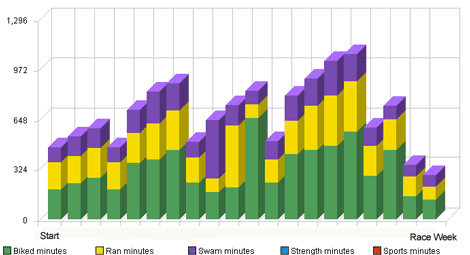 If, however, you are a competitor, then it is YOUR responsibility to do everything in your power to be the best athlete you can be. Whether you have a coach or not, it is your responsibility to know why you're doing certain workouts and how they work. I don't mean just that you can set up a season based on Periodization 101. I mean KNOW YOUR SHIT! It's YOUR responsibility to not flake on workouts whenever possible (and to NOT do the ones that you know will be bad for you). It's your responsibility to eat well and at the right times to fuel yourself. If there's one thing that gets on my last nerve more than someone who trains like a penguin and wants to be a cheetah, it's someone who considers themselves a "serious athlete," and yet they don't understand basic training principles, nutritional principles, and they slack off in half their workouts. I think that people who only train their strengths deserve what they get. If you want to be competitive, training has to be a priority. Because I'm sure training's a big priority for your competition, and you want to beat them, don't you?
If you want to be competitive, you have to assume that every single one of your competitors is out there training as hard as you or harder. On the day that you run so hard you almost puke, you have to assume your competitor wouldn't be afraid to hurl. You have to trust that your competitor isn't out there missing workouts. Your competitor isn't eating cookies and ice cream just because he/she had a bad day. Your competitor doesn't treat his/her bike like crap. Your competitor isn't staying up late at night and burning the candle at both ends. Your competitor is spending all his/her free time when they're not training reading, listening, and looking for ways to be better. You have to assume that your competitor is going to be just as diligent as the ideal you. If you've done everything within your power to be your best on race day, you'll know you're ready. Whether the Ideal You is good enough on race day to beat the competition is out of your control. But if you've done your homework, and studied AND practiced the sport (i.e. if you really know what you're doing) you'll know in your heart of hearts if you did everything you could do to be prepared for that day, or if the Ideal You got away from you. (Because in the end, we can only compete against ourselves). And only if you've absolutely, positively done everything that the Ideal You could have done, only THEN can you gripe about how life just isn't fair. For some reason, I doubt when that day comes that you'll be disappointed with the result, whatever it may be.
If you show up to races just to see the pretty trees and hills in a new place and hang out with old friends and new faces, that's great. I think that that's a worthy goal, and since this is my page, what I say is absolute truth. Don't let anyone tell you that participating's not good enough. That's enough for you, and no one should let you feel inferior for it. Train to finish comfortably and have fun. You can always change your mind and decide to train to be more competitive later, but only if you want to. But if that's the way you've trained, then don't sit there and gripe and grumble at the end of the race about how slow you are and how it's not fair. You're not allowed to train like a penguin and expect yourself to be a cheetah. Then again, if this is your style, you probably stopped reading this long ago.If, however, you are a competitor, then it is YOUR responsibility to do everything in your power to be the best athlete you can be. Whether you have a coach or not, it is your responsibility to know why you're doing certain workouts and how they work. I don't mean just that you can set up a season based on Periodization 101. I mean KNOW YOUR SHIT! It's YOUR responsibility to not flake on workouts whenever possible (and to NOT do the ones that you know will be bad for you). It's your responsibility to eat well and at the right times to fuel yourself. If there's one thing that gets on my last nerve more than someone who trains like a penguin and wants to be a cheetah, it's someone who considers themselves a "serious athlete," and yet they don't understand basic training principles, nutritional principles, and they slack off in half their workouts. I think that people who only train their strengths deserve what they get. If you want to be competitive, training has to be a priority. Because I'm sure training's a big priority for your competition, and you want to beat them, don't you?If you want to be competitive, you have to assume that every single one of your competitors is out there training as hard as you or harder. On the day that you run so hard you almost puke, you have to assume your competitor wouldn't be afraid to hurl. You have to trust that your competitor isn't out there missing workouts. Your competitor isn't eating cookies and ice cream just because he/she had a bad day. Your competitor doesn't treat his/her bike like crap. Your competitor isn't staying up late at night and burning the candle at both ends. Your competitor is spending all his/her free time when they're not training reading, listening, and looking for ways to be better. You have to assume that your competitor is going to be just as diligent as the ideal you. If you've done everything within your power to be your best on race day, you'll know you're ready. Whether the Ideal You is good enough on race day to beat the competition is out of your control. But if you've done your homework, and studied AND practiced the sport (i.e. if you really know what you're doing) you'll know in your heart of hearts if you did everything you could do to be prepared for that day, or if the Ideal You got away from you. (Because in the end, we can only compete against ourselves). And only if you've absolutely, positively done everything that the Ideal You could have done, only THEN can you gripe about how life just isn't fair. For some reason, I doubt when that day comes that you'll be disappointed with the result, whatever it may be.
Conclusion
As you may have guessed, this is more of a pep talk to myself than anything else. Feel free to ignore me or call me wrong. But if you sat here and spent all that time reading what I just wrote, please don't comment that I'm boring. You could have navigated away at any time. If you read it, it's not because I made you. Go off and write one of these for yourself if you want. Anyway, I hope this gives SOMEONE some food for thought at least. Certainly writing it has helped me work out some thoughts.
